
"I want to start an online business." It's the most common phrase I hear in 2026. And why not? The digital economy in Nepal is booming. With internet penetration reaching 70% and digital payments like Fonepay becoming the norm, there has never been a better time to sell online. The market is no longer just early adopters; your grandmother in Jhapa is probably buying shawls on Facebook.
However, the "Wild West" days of 2020 are over. You can't just create an Instagram page, post stolen photos, and call it a business. The E-Commerce Act of 2025 has introduced strict regulations. Competition is fierce. To succeed today, you need a roadmap.
This is that roadmap. A complete, step-by-step masterclass on starting a legitimate, profitable e-commerce business in Nepal in 2026.
Phase 1: Legal Registration (Don't Skip This!)
Since the new laws passed last year, operating an unregistered online business can lead to heavy fines (up to Rs. 50,000 for first offense). Plus, you can't get a payment gateway without registration. Here is the checklist:
1. Choose Your Structure
- Sole Proprietorship (Ekal): Best for solo founders. Register at your local Ward Office or Department of Cottage & Small Industries (DCSI). Cost: ~Rs. 5,000.
- Private Limited (Pvt. Ltd.): Best if you have partners or want to raise investment later. Register at the Office of the Company Registrar (OCR) in Tripureshwor. Cost: ~Rs. 15,000+.
2. PAN & VAT
Visit the Inland Revenue Department (IRD). Getting a PAN is mandatory regarding of income. Do you need VAT? Mandatory if your annual turnover exceeds Rs. 50 Lakhs (for goods) or Rs. 20 Lakhs (for services). Voluntary registration is also possible and recommended if you import goods, as you can claim back the VAT paid at customs.
3. The New Requirement: E-Commerce Portal
Under the 2025 Act, you must list your verified business on the Department of Commerce's central e-commerce portal. This builds trust with customers who can verify your legitimacy. You will get a digital "Verified E-Seller" badge to display on your site.
Phase 2: Product Sourcing Strategy
You have your papers. Now, what are you selling? "General Store" is a dead model. You need a niche. (e.g., "Ergonomic Chairs for WFH" is better than "Furniture").
Niche Selection Strategy
Don't just sell what everyone else is selling (like generic smartwatches). Look for gaps. In 2026, we are seeing huge demand in:
- Pet Accessories: Nepalis are spending more on pets than ever before.
- Sustainable Products: Bamboo toothbrushes, cloth bags, and erratic lifestyle products.
- Educational Toys: Parents are moving away from screens and buying Montessori toys.
Option A: Importing from China (Alibaba/Taobao)
Most electronics and fashion come from here.
How to do it: You can't just order directly to Kathmandu easily. You need a
Cargo Agent (freight forwarder).
Process: Order on Alibaba → Ship to Agent's Guangzhou Warehouse →
Agent clears Nepal Customs → Delivered to your KTM storeroom.
Time: 15-25 days by road (Kerung border).
Cost: Product Cost + Shipping (Rs. 300-500 per kg) + Customs (varies).
Option B: Sourcing Locally (Made in Nepal)
Textiles, Pashmina, Shoes (Goldstar/Caliber), and organic foods are great local options.
Pros: Faster restock, no customs headache, "Support Local" marketing angle.
Cons: Limited variety compared to China.
Option C: Dropshipping (Is it dead?)
Dropshipping in the traditional Western sense (Oberlo -> Shopify) doesn't work well in Nepal due to long delivery times. However, "Local Dropshipping" is emerging. Platforms like Neshop allow you to resell their inventory without holding stock. You market the product, get the order, and Neshop fulfills it. This is the lowest risk way to start.
Phase 3: Website vs. Marketplace (The Big Decision)
This is where most beginners fail. They spend their entire budget building a fancy website and have Rs. 0 left for marketing.
Path A: Your Own Website
Using Shopify or WordPress (WooCommerce).
- Setup Cost: Rs. 50,000 - 1 Lakh.
- Monthly Cost: Hosting ($10) + Plugins.
- Marketing: YOU have to bring 100% of the traffic.
- Control: 100% Yours. Customer data is yours.
Path B: Joining a Marketplace
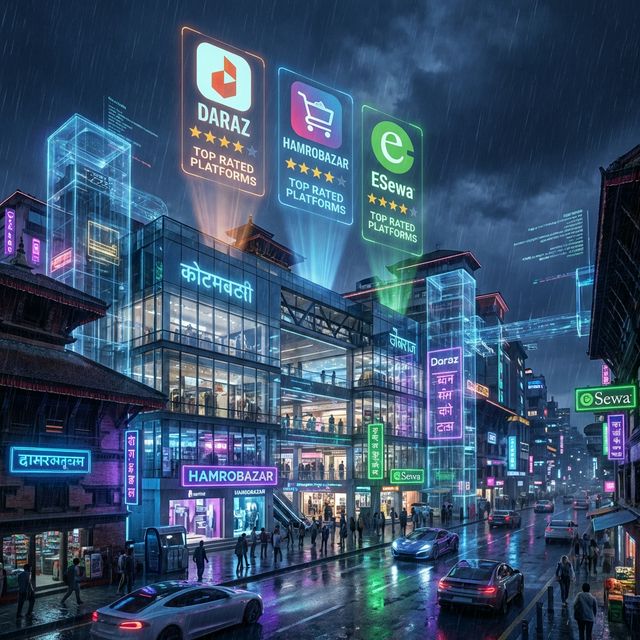
Selling on Neshop or Daraz.
- Setup Cost: Rs. 0.
- Monthly Cost: Rs. 0.
- Marketing: Platform brings traffic.
- Control: Limited. You compete with others.
My Recommendation for 2026: Start on a marketplace like Neshop. Why? Because Neshop charges 0% commission. You effectively get a free online shop with built-in traffic and logistics. Once you cross 100 orders a month, then invest in your own website for branding. Building a website from day one is like opening a shop in the middle of a desert and hoping people find it.
Phase 4: Logistics & The "Last Mile"
If you control delivery, you control the experience.
Inside Valley: Use services like Upaya City Cargo or Pathao
Parcel. They offer same-day delivery. Rates are usually Rs. 100-150.
Outside Valley: Use Nepal Can Move (NCM) or Aramex. They have
hubs in all major cities.
Returns Management: Expect a 10-15% return rate. Factor this into your pricing.
If you
sell clothes, returns will be higher (size issues). You need a clear policy: "Video Unboxing
Mandatory for Damage Claims" to prevent fraud.
Packaging Matters
In 2026, customers hate plastic. Use cardboard boxes or recycled paper bags. It costs Rs. 5 more but elevates your brand value. People post "Unboxing" videos on Instagram—make sure your packaging looks good enough to share.
Phase 5: Digital Marketing in 2026
Boosting a post on Facebook is not enough anymore. The algorithm has changed.
- TikTok & Reels: Organic reach is still alive here. Create "Behind the Scenes" content or "Packing Orders" videos. They go viral easily. Do not just post product photos; post stories.
- Influencer Marketing: Don't hire celebs. Hire "Micro-influencers" (5k-10k followers) in your niche. They are cheaper and their audience actually trusts them. Send them free product in exchange for a genuine review.
- SEO (Search Engine Optimization): If you have a website, write blogs about your niche. If you sell hiking gear, write "Best Hiking Trails in Shivapuri." Google will send you free traffic.
- Email/SMS Marketing: Collect customer numbers. Send them an SMS when you have a sale. The open rate for SMS in Nepal is 98%.
The Financials: How Much Capital Do You Need?
Let's break down a lean startup budget for importing niche gadgets.
| Expense Item | Estimated Cost |
|---|---|
| Company Registration & PAN | Rs. 15,000 |
| Initial Stock (Inventory) | Rs. 100,000 |
| Packaging Materials | Rs. 5,000 |
| Marketing (Ads) | Rs. 20,000 |
| Misc/Contingency | Rs. 10,000 |
| TOTAL | Rs. 150,000 |
Real Success Stories (Case Studies)
Case Study 1: The Sneaker Reseller
The Idea: Suresh noticed that "First Copy" shoes were popular but quality was inconsistent. He sourced "Master Quality" reps from a specific factory in China.
Execution: He started an Instagram page. He made videos comparing his quality vs normal market quality. He sold on Neshop to handle delivery.
Result: Within 6 months, he was selling 200 pairs a month with a profit of Rs. 1000 per pair. Total Profit: Rs. 2 Lakhs/month.
Case Study 2: The Organic Tea Brand
The Idea: Meena's family had a tea garden in Ilam. She realized city people wanted authentic tea but supermarkets sold stale dust.
Execution: She created premium packaging using Lokta paper. She sold "Gift Sets" for Dasain/Tihar. She used TikTok to show the plucking process.
Result: She now exports to Japan and sells locally via her own WooCommerce site.
5 Mistakes That Will Bankrupt You
- Underpricing: Forgetting to account for returns and ads in your margin. Always aim for 30%+ net margin.
- Ignoring Customer Service: In Nepal, customers call. Answer the phone! If you don't pick up, they assume you are a scam.
- Overstocking: Buying 100 units of a trendy item before testing 10. Start small, validate, then scale.
- Ignoring Data: Not tracking which ad creative is bringing sales. Cut the losers, scale the winners.
- Quitting Too Soon: The first 3 months are dead silence. Push through. Consistency is the only secret.
Comments (6)
Leave a Comment
The VAT threshold is actually 20 Lakhs for services right? Thanks for clarifying. I was confused.
I started selling handmade jewelry on Neshop last month. It's so much easier than managing my own website which kept crashing.
That's great to hear Sita! Neshop's simplicity is definitely beginner-friendly. Good luck with your jewelry business!
How much capital do I need to start importing from China?
It depends, Bishal. But you can start small with 1-2 Lakhs if you pick lightweight, high-value items.
Great outline. Phase 4 is the hardest. Dealing with delivery boys in KTM is a nightmare sometimes.
Is it mandatory to register initially? Can I test without registration?
Technically illegall to run without registration, but many test the waters for 1-2 months. But once you start getting orders, register asap to avoid fines.